
Have you ever wondered what role ancestry plays in Type 2 diabetes? In a recent study, researchers investigated the genetic links associated with the condition and other health disorders.
What is Diabetes?
Diabetes mellitus is a complex metabolic health condition. It is the body’s functional
impairment in insulin secretion and insulin resistance, leading to chronic elevated sugar levels in the blood . Produced in the pancreas, insulin hormones function to convert blood sugar into usable energy, regulate energy storage, and maintain energy balance within the body. In individuals with Type 1 diabetes, the immune system is in dysfunction, attacking the body’s own insulin-forming
cells and causing persistent insulin deficiency. Individuals with Type 2 diabetes are both resistant to insulin and poor at responding to blood sugar levels.
What Causes Type 2 Diabetes?
Similar to the other types of diabetes, Type 2 diabetes can result from multiple determinants. This includes individual life choices, societal upbringing, environment, and genetic factors. In particular, Type 2 diabetes has higher prevalence in individuals from poorer societal upbringing, including those with lower income or education, poorer childhood upbringing, lack of support networks, or lack of accessibility to healthcare. Life choices and environment are also large contributors, with those who smoke tobacco, have low intake of fruits and vegetables, are obese, or physical inactivity youths at higher
risks.
The Health Impacts of Diabetes
The onset of Type 2 diabetes vastly ranges depending on the individual’s heredity. This includes the symptoms, age on onset, and the optimal treatment method
(reference). As of 2023, the World Health Organization estimates that 10% of adults worldwide have diabetes. When prediabetic symptoms are accounted for, the prevalence increases to 30%. If not controlled, diabetes can lead to a broad range of health complications. It is associated with working adult vision loss, 3-fold higher cardiovascular disease hospitalisation rates, 20-fold higher foot ulcers and lower limb amputations, significant morbidity, and premature death. Individual management typically involves maintaining a healthy weight, physical activity, or regular medication.
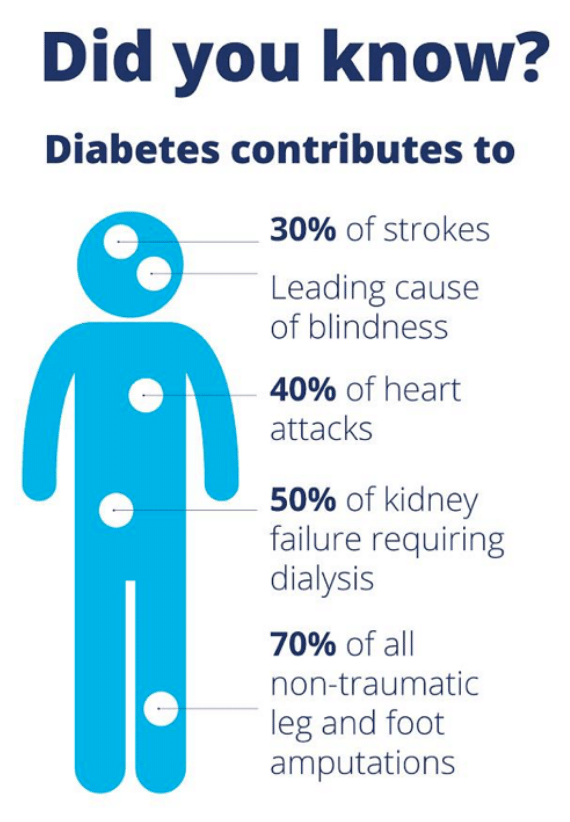
An infographic of the five main complications due to diabetes.

An infographic of the choices that can be taken to reduce the risk of Type 2 diabetes.
What is the Study About?
In 2024, this article evaluated the contribution ancestry has on Type 2 diabetes. The researchers used a genome-wide association study (GWAS) of over 2.5 million diverse individuals, along with additional single-cell epigenomics data from disease-related cells. The GWAS research approach analyses genetic variations across entire genomes to identify any contributing gene(s) and by applying single-cell epigenomics, data is gathered on a cell-to-cell basis. The researchers confirmed over 600 genes (a.k.a loci or the location of a gene) to be independently associated with Type 2 diabetes, with 145 of them newly discovered. Moreover, 8 clusters (a group of closely located genes) were found to be related to cardiometabolic factors (conditions that involve both the cardiovascular and metabolic systems) that were specific to different cell types.
To understand these clusters, an additional analysis was conducted with 300,000 new individuals. The researchers confirmed that several obesity-related factors contribute to the development of cardiometabolic health issues. The researchers also constructed polygenic risk scores (predisposition for a disease from the cumulative effect of multiple genes) to investigate any association between ancestry groups and the progression from larger blood vessels (macrovascular) to smaller blood vessels (microvascular) health concerns.
How Did the Researchers Conduct Their Experiment?
The GWAS was organized into six ancestry groups: Europeans, East Asians, African Americans (including West Africa and Europe), Hispanics from America, South Asians, and South Africans. By incorporating multi-ancestry meta-regression statistical data, researchers correlated specific genes to a diverse group of ancestries, ensuring a more comprehensive and unbiased result. Moreover, to account for smaller signals, the researchers focused on downstream single-nucleotide variants (SNVs), finding 36 additional loci of significance. This added to the total of 1289 distinct signals, including 611 loci, that contribute to Type 2 diabetes. By applying unsupervised machine learning methods, these signals were then linked to a plethora of other signals, including 8 distinct cardiometabolic profiles. This data is visualised in clusters below to better understand the shared biological pathways that these genes have with other health disorders.
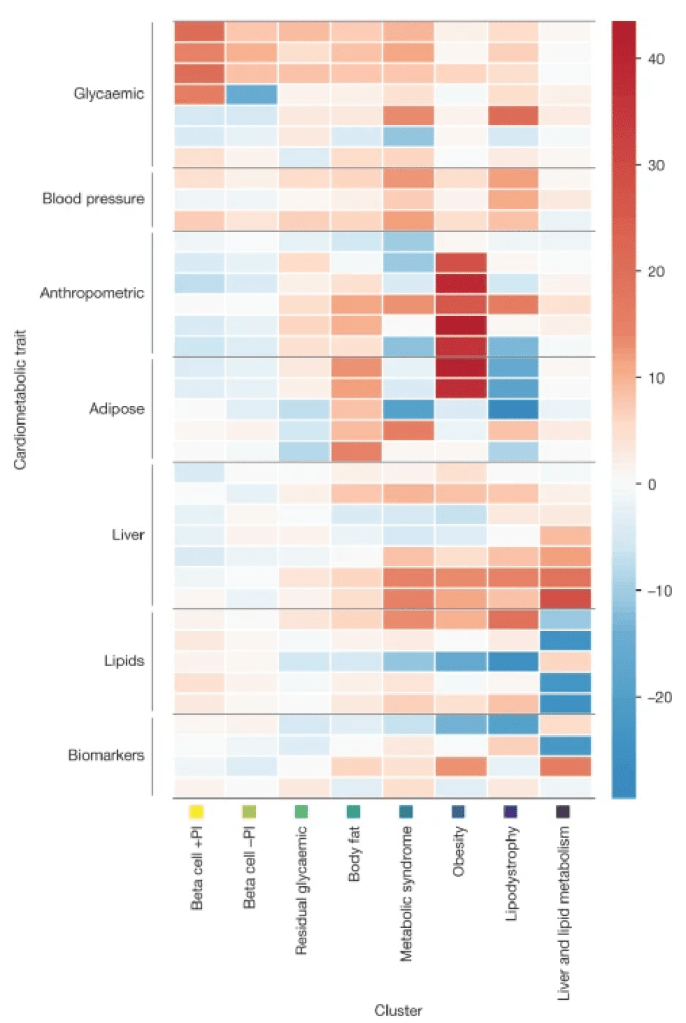
The figure illustrates the correlations found from the SNVs association. The column represents the clusters and the rows represent the physical cardiometabolic symptoms.
What Did the Researchers Conclude?
Researchers confirmed that factors including poor liver or lipid metabolism, uneven body fat distribution (lipodystrophy), and obesity negatively impact insulin resistance. The lipodystrophy cluster was attributed to the highest insulin resistance, the beta cell + PI cluster had the strongest association to gestational diabetes mellitus, and the obesity cluster was most strongly associated with polycystic ovary syndrome.
The researchers also discovered three new cardiometabolic signals: accumulation of body fat, residual blood-glucose (glycaemic) effects, and a cluster of conditions known as metabolic syndrome. Of the 1289 signals associated with Type 2 diabetes, 127 (9.9%) were correlated to ancestry, over three times the expected amount. These SNVs showed stronger connections to genetic ancestry than compared to any other factor analyzed in the GWAS. In particular, the highest correlations for Type 2 diabetes were those of East Asian ancestry. These individuals were prone to beta-cell dysfunction, a condition which causes reduced insulin secretion and lower insulin resistance. Alternatively, the highest correlations for obesity and lipodystrophy were those of European ancestry with these conditions linked to reduced insulin sensitivity and higher insulin resistance, respectively. The main variation determinant between East Asian and European ancestries was BMI. That is to say that for Type 2 diabetes, the predominant varying factor amoung individuals is their body weight.
The most consequential complications of Type 2 diabetes were macrovascular-related. Supporting previous findings, researchers concluded that macrovascular conditions had a negative correlation with beta-cell + PI clusters, a positive correlation with obesity clusters, and no correlation to ancestry. In particular, there were significant associations to earlier age of onset for Type 2 diabetes among the obesity cluster. The polygenic risk scores were also strongly correlated to microvascular related concerns, including higher instances of hospitalisation for heart failure.
Why Does This Matter?
As each individual varies genetically, so do their susceptibilities to Type 2 diabetes. Studying the relevancy that genes have to Type 2 diabetes gives researchers insight on optimal interventions and targeted treatment plans. Clinical incorporation of these findings also include improved risk assessments, earlier detection, and personalized patient care.
This study also contributes to the overall understanding of gene associations and pathways involved in Type 2 diabetes across different ancestries. It lays the groundwork for future targeted drug discoveries and the foundations for further comprehensive computational analyses in the continuing evolving genomic research community.
Additional Resources
- Gene Databases
GWAS Catalog
The database of Genotypes and Phenotypes (dbGaP) - Research Organizations
International Diabetes Federation (IDF)
Canadian Diabetes Association (CDA)
Genome Canada - Clinical Trial Registries
Canadian Clinical Trials Registry - Educational Material
Diabetes Canada
Canadian Society of Endocrinology and Metabolism (CSEM)
References
- Canada Protection Plan. (2023, September 12). Types of Diabetes. Retrieved from
https://www.cpp.ca/blog/types-of-diabetes/ - Diabetes Canada. Diabetes in Canada. Retrieved from
https://www.diabetes.ca/advocacy—policies/advocacy-reports/national-and-provincial-backgrounders/diabetes-in-canada - Statistics Canada. (2023, November 29). Diabetes among Canadian adults. Retrieved from https://www.statcan.gc.ca/o1/en/plus/5103-diabetes-among-canadian-adults
- Suzuki, K., Hatzikotoulas, K., Southam, L., Taylor, H. J., Yin, X., Lorenz, K. M., … Zeggini, E. (2024). Genetic drivers of heterogeneity in type 2 diabetes pathophysiology. Nature. https://doi.org/10.1038/s41586-024-07019-6
About the author
This post was written by Alena Ho who recently completed her undergraduate degree at University of Toronto in Molecular Biology. She has previously interned as a research assistant at Bayer and the Canadian Space Agency. Passionate about the field of biological data analysis, she intends to pursue a career in bioinformatics or R&D.
Featured image by United States Geological Survey on Unsplash (license).
 The Genomic Odyssey