
Life is filled with unpredictable tragic events. Experiencing a central nervous system injury is one of them. Unlike our skin, which can heal itself, the injured parts of the central nervous system often die due to a lack of regenerative capability, causing permanent mental and physical disability. But a recent study uncovered that animals may have the secret ability to regrow injured parts of the central nervous system.
The nervous system, the command center of the human body, is responsible for regulating and coordinating all of the body’s systems. The brain and spinal cord make up the central nervous system (CNS), while the nerves branching out of the spinal cord make up the peripheral nervous system (PNS). Various regions of the CNS are associated with the proper functioning of different body parts with the help of the PNS. The CNS and PNS not only differ in their location and function but also demonstrate significant differences in the way they respond to injuries.
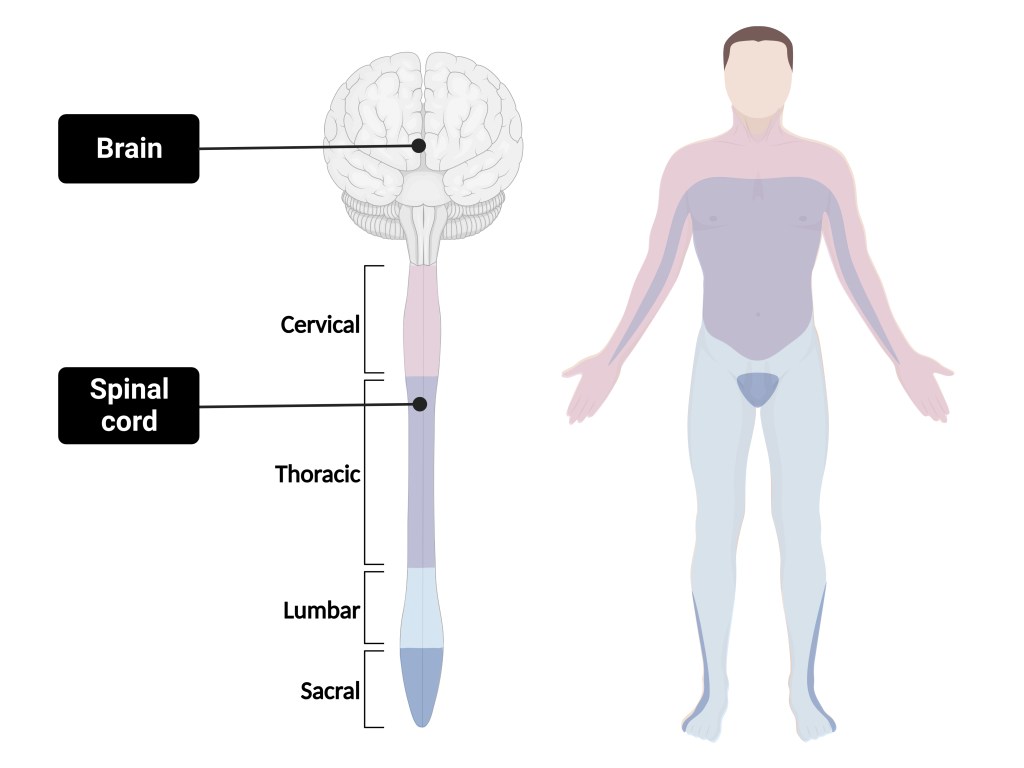
The central nervous system consists of two main parts: the brain and the spinal cord. The brain is responsible for controlling the entire body, while the spinal cord acts as a bridge between the brain and the rest of the body for the exchange of information. The spinal cord is divided into four regions (cervical, thoracic, lumbar, and sacral), each region responsible for controlling the function of various regions of the body (as shown in different colours).
A pinched nerve is one of the most common forms of PNS injury and it heals through time on its own. This is due to the regenerative ability of the PNS, or the ability to replace the dead non-functional neurons (the building blocks of the nervous system) with new functional neurons. On the other hand, the CNS is not able to regenerate new neurons or damaged parts of neurons (such as axons) following injuries. These injuries disconnect the respective body parts from the CNS, which makes CNS injuries life-threatening events that can lead to mental and physical disability as well as lifelong paralysis.

The neuron is a specialized cell of the nervous system responsible for communicating signals throughout the body. The outgrowths (dendrites) of the cell body (soma) receive the signal, which passes through the axon (like an insulated electrical wire) and transfers the signal to another neuron via axon terminals. A nerve is a group of neurons running from one location to another.
Every minute, around two individuals in the world, undergo CNS injury due to falls, motor vehicle accidents, sports injuries, violence, or medical conditions. There exists no treatment to regenerate the CNS. In a recent review, Nagappan et al. (2020) suggest various causes for the inability of the CNS to regenerate, including the dysregulation of gene expression neurons. Genes expression is typically regulated by the activity of transcription factors, DNA-binding proteins that enable the expression of certain genes in certain conditions.
A recent study by Cheng et al. (2022) compared the differential gene expression between PNS and CNS injuries. The transcription factors determined to be responsible for abnormal gene expression between both injuries were found using bioinformatic tools. This approach uses computation techniques to process and analyze genomic data into meaningful biological observations. They came to the conclusion that REST (a silencing transcription factor or transcriptional repressor) inhibited the activity of various transcription factors that halted the regeneration of axons following CNS injuries. To validate their results, they conducted an in vivo experiment in mice. Strikingly, the inhibition of REST leads to 3 times more axon regeneration following a CNS injuries in mice. These results highlight the critical role of REST in regulating the regenerative capacity of the CNS. By breaking down this barrier, the self-ability of the CNS to regenerate can be unleashed, allowing it to recover from injuries in a manner similar to the PNS.
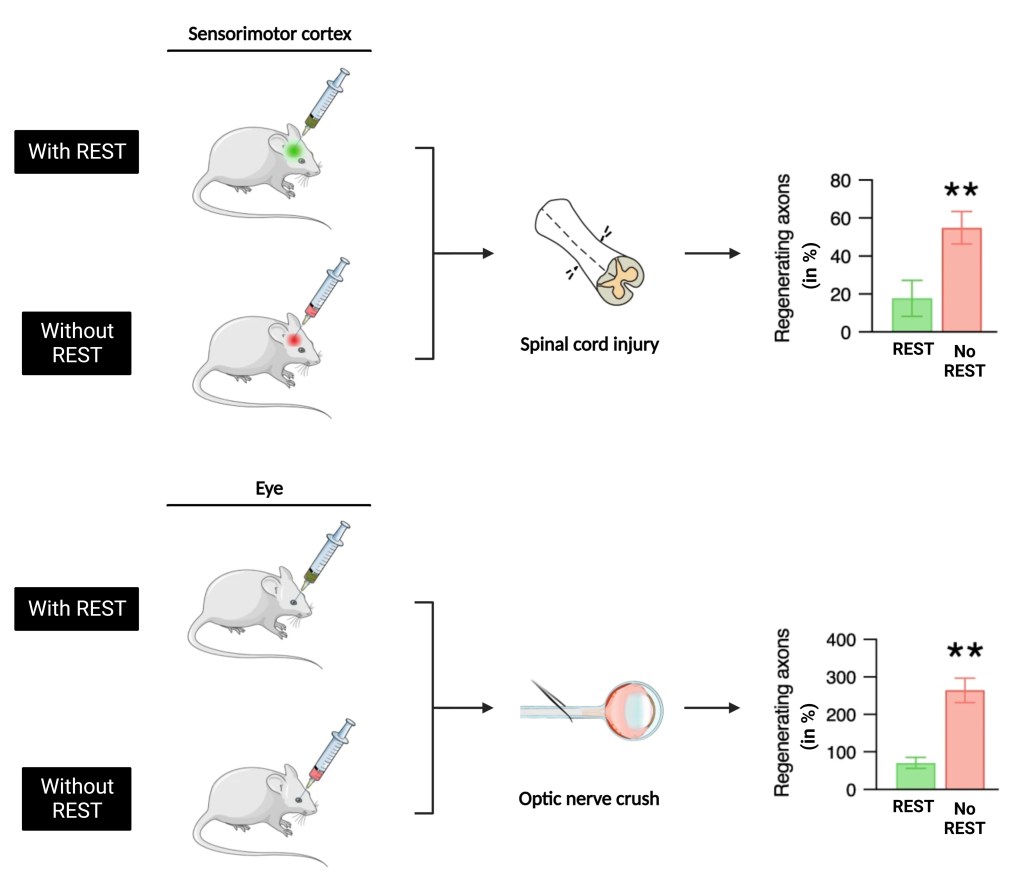
Schematic representation of in vivo experiments for central nervous system regeneration in mice with REST and without REST. For both types of CNS injury models, spinal cord injury and optic nerve crush, the mice were divided into two groups: with REST or without REST. The axonal regeneration was traced for both groups following injuries. After the injury, the percentage of regenerating axons was significantly higher in mice without REST than in mice with REST.
In summary, this study used bioinformatics to discover that the transcription factor REST suppresses the expression of the genes responsible for promoting regeneration in the CNS. These research findings may eventually translate into clinical trials, but it is a long way ahead before any possible translation to humans.
Learn more about bioinformatics in neuroscience
- Bioinformatics analysis of the molecular mechanisms underlying traumatic spinal cord injury
- Bioinformatics analysis of long non-coding RNAs involved in nerve regeneration following sciatic nerve injury
About the author
Akshat D. Modi is a fourth-year HBSc student specializing in Human Biology at the University of Toronto. With a curiosity for unraveling the complexities of human pathologies, he is actively engaged in various biomedical research projects at University Health Network. As a lifelong learner and aspiring surgeon-scientist, he seeks opportunities to learn from senior scientists, acquire cutting-edge research techniques, develop novel therapeutics to improve patient outcomes, and bridge the gap between the scientific community and the general public, making biomedical concepts accessible and inspiring others to explore the field.
 The Genomic Odyssey
Brilliant work 🙂
LikeLike